

Why Enclose Your 3D Printer?
Why Enclose Your 3D Printer?
Every 3D printer emits VOCs and ultrafine particles during operation — even when printing PLA. An enclosure is the single most effective way to protect your health, improve your print quality, and meet growing safety requirements.
The Health Case: What You're Actually Breathing
There's a common misconception in the 3D printing community that PLA is "safe" because it's derived from renewable sources like corn. The reality is more complicated. Every thermoplastic filament — including PLA — releases volatile organic compounds (VOCs) and ultrafine particles (UFPs) when heated through a nozzle. These particles are small enough (1–100 nanometers) to penetrate deep into the lungs, and research shows they can be difficult for the body to clear.
The EPA has studied 3D printer emissions extensively and found that both PLA and ABS release respirable ultrafine particles during printing. ABS produces roughly three to four times more emissions than PLA, but PLA is far from zero. Researchers have identified formaldehyde, acetaldehyde, styrene, and other compounds classified as known or probable carcinogens (IARC Class 1 and 2) in 3D printer emissions across multiple filament types.
One comprehensive study detected over 200 individual VOCs emitted from just five different filaments. The specific compounds released vary depending on the filament material, brand, color, and extrusion temperature — meaning there is no single "safe" filament that eliminates exposure entirely.
What about "low emission" filaments? Even filaments marketed as low-emission still produce ultrafine particles and VOCs. The emission profile changes with print temperature, print speed, and filament color. Darker colors and higher temperatures generally increase emissions. The only reliable way to manage exposure is to contain and filter emissions at the source — which is exactly what an enclosure does.
The concern compounds with duration. A single short print may produce exposure levels within regulatory limits. But hobbyists running multi-hour prints, print farms operating around the clock, or classrooms with printers running all day are accumulating exposure over weeks, months, and years. Long-term cumulative exposure is where the research raises the most concern.
Children and Vulnerable Populations
3D printing has become one of the most popular educational tools in STEM programs, which means children and teenagers are regularly exposed to printer emissions. The EPA specifically flagged this as a concern — children's respiratory systems are still developing, and they may be disproportionately affected by ultrafine particle exposure. EPA researchers have used particle dosimetry modeling to estimate how 3D printer emissions deposit in children's lungs across age groups from three months to eighteen years. The results reinforce the need for proper containment and ventilation in any environment where children are present near operating printers.
The Print Quality Case: Better Conditions, Better Results
Beyond health, an enclosure creates a fundamentally better printing environment. Temperature stability is the biggest factor. When the air around a print stays consistent, each layer bonds more reliably to the one below it. The result is fewer failed prints, less warping, stronger layer adhesion, and better surface finish.
Temperature Stability
Eliminates drafts from HVAC, open windows, and foot traffic. Critical for ABS, ASA, Nylon, and PC — but even PLA benefits on large or long-duration prints. Prevents the uneven cooling that causes warping and layer separation.
Dust & Debris Protection
Keeps particles off rails, lead screws, belts, and the nozzle area. Dust on moving parts accelerates wear, causes clogs, and degrades print quality over time — especially in garages, workshops, and basements.
Advanced Materials
ABS, ASA, Nylon, and polycarbonate require elevated and stable ambient temperatures to print successfully. Without an enclosure, these materials warp, crack, and delaminate. An enclosure unlocks your printer's full material range.
Humidity Control
A sealed enclosure can be paired with desiccant or dry storage to keep moisture away from hygroscopic filaments during printing — reducing stringing, bubbling, and weak layer bonds caused by wet filament.
Cold, Dusty, and Uncontrolled Environments
Many makers run printers in garages, workshops, or unheated spaces where temperatures fluctuate dramatically — especially overnight. An enclosure buffers against these swings, keeping the print chamber stable regardless of what's happening in the room. It also keeps sawdust, shop debris, pet hair, and general household dust out of the printer mechanics and off the print surface.
Noise Reduction
3D printers produce a combination of sounds — stepper motors, cooling fans, part cooling blowers, and the repetitive motion of the toolhead — that can range from mildly annoying to genuinely disruptive. In a shared workspace, home office, bedroom, or apartment, printer noise can interfere with calls, sleep, and daily life. Overnight prints are particularly problematic.
An acrylic enclosure provides a physical barrier that dampens sound transmission. It won't make the printer silent, but it meaningfully reduces the volume — typically enough to make the difference between "can hear it through the wall" and "barely noticeable." For anyone printing near family, roommates, neighbors, or coworkers, this alone can be worth the investment.
Why Enclose an Already-Enclosed Printer?
This is one of the most common questions we get: "My Bambu P2S (or H2S, or X1C) already has an enclosure. Why would I add another one?"
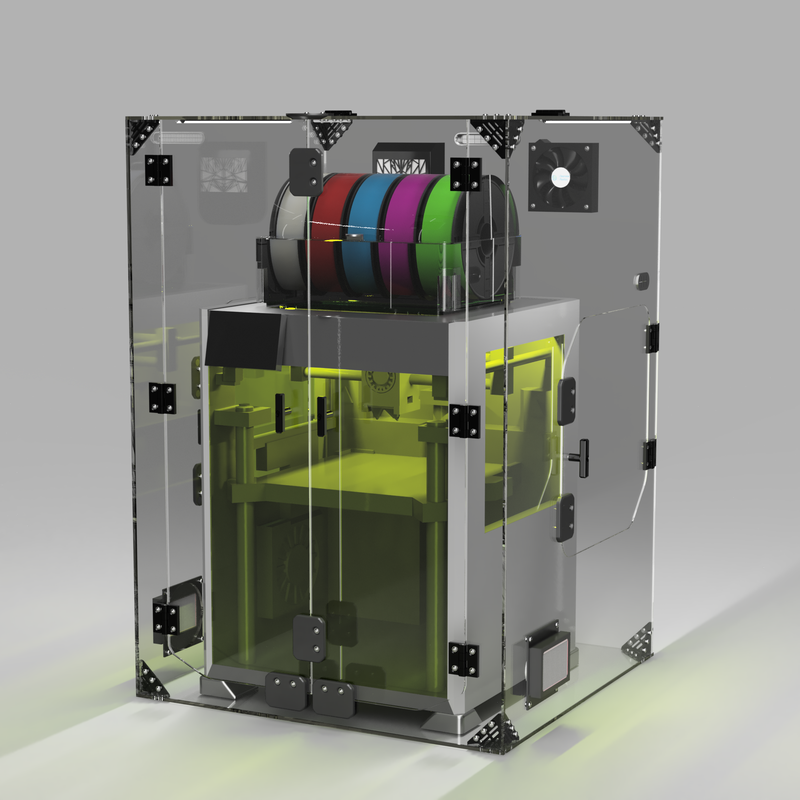
The stock enclosure on a CoreXY printer like the P2S or H2S is designed primarily to maintain print chamber temperature for better print quality with engineering materials. It's excellent at that job. But it was not designed to fully contain fumes and particulate. Air vents, the filament entry path, panel gaps, and exhaust ports all allow emissions to escape into your room.
An outer enclosure captures what the inner enclosure lets through. It gives you a sealed environment where you can route exhaust to a carbon filter, HEPA filter, or directly out a window — controlling where those emissions go rather than breathing them in. This is especially important when printing ABS, ASA, or Nylon, where the stock enclosure keeps the chamber warm but actively vents fumes into your space through the built-in exhaust.
The outer enclosure also adds a second layer of noise reduction and dust protection, and provides a controlled environment that keeps the printer's ambient conditions stable even in fluctuating room temperatures.
Compliance: Schools, Institutions, and Workplaces
The regulatory landscape around 3D printer safety is evolving rapidly. If you're operating printers in a school, university, makerspace, library, or workplace, there's a growing body of requirements you should be aware of.
Federal Guidance
In 2023, the National Institute for Occupational Safety and Health (NIOSH) published "Approaches to Safe 3D Printing," a comprehensive guide specifically addressing non-industrial settings like schools, libraries, makerspaces, and small businesses. The report recommends ventilated enclosures as an engineering control to reduce exposure to ultrafine particles and VOCs. NIOSH considers enclosures more efficient than general room ventilation alone for capturing emissions at the source.
The EPA continues to study 3D printer emissions, with particular focus on children's exposure in school environments. Their research has confirmed that both PLA and ABS emit respirable ultrafine particles and that children represent a vulnerable population.
University Policies
Major universities have already implemented formal 3D printer safety policies that require or strongly recommend enclosures. These policies are increasingly common and tend to include similar requirements:
Princeton University requires dedicated exhaust ventilation or ventilated enclosures for all 3D printers, mandates HEPA and charcoal filtration connections, and prohibits 3D printer use in residential housing units entirely.
University of Rochester directs departments to purchase enclosed printer models when possible, with preference given to enclosures with HEPA and VOC filtration capabilities, and requires a minimum of 6 air changes per hour in rooms with printers.
University of Florida requires that printers using ABS or Nylon must be used in work areas with local exhaust ventilation and must be fully enclosed whenever possible. Even PLA-only printers are limited to one per standard office.
Stanford University recommends dedicated exhaust systems including ventilated enclosures, and notes that enclosure exhaust can be routed outdoors via window kits for small operations.
Yale University requires EHS review prior to purchasing any 3D printer and mandates ventilation solutions including ventilated enclosures for all printing operations.
Ohio State University identifies enclosures as critical engineering controls that contain emissions, provide physical protection from hot surfaces and moving parts, and contribute to a safer working environment overall.
The trend is clear: institutions are moving from "recommended" to "required" when it comes to 3D printer enclosures. If you're responsible for a print lab, makerspace, or classroom, implementing enclosures now positions you ahead of evolving compliance requirements and demonstrates a commitment to protecting students and staff.
K-12 Schools
3D printers are now common in elementary through high school STEM programs. Field studies monitoring air quality in school classrooms during 3D printing have shown elevated particulate matter and total VOC concentrations near operating printers. In some cases, formaldehyde concentrations exceeded recommended indoor levels during ABS printing. These findings have prompted safety organizations to publish guidance specifically for K-12 environments, emphasizing the importance of enclosed printers, filtration systems, and proper ventilation.
Workplace Standards
Under OSHA's General Duty Clause, employers are required to provide a workplace free from recognized hazards. While there is no OSHA-specific standard for 3D printer emissions (yet), the existing body of research on VOC and ultrafine particle exposure creates a clear basis for implementing engineering controls. An enclosure with proper filtration is the most practical and cost-effective way to meet this obligation for desktop 3D printing operations.
The Bottom Line
Whether you're a hobbyist printing in your living room, a teacher running a STEM lab, or a business operating a print farm — an enclosure protects your health, improves your print quality, reduces noise, extends your printer's lifespan, and keeps you ahead of evolving safety requirements. Even if your printer already has a built-in enclosure, a secondary outer enclosure gives you the fume containment, filtration routing, and environmental control that stock enclosures weren't designed to provide.
Find the Right Enclosure for Your Printer
We make enclosures for Bambu Lab, Prusa, Creality, Elegoo, and more — plus fully custom builds for any machine.
Shop EnclosuresSources & Further Reading
-
EPA — 3D Printing Research at EPA
Overview of EPA's ongoing research into 3D printer emissions, ultrafine particles, and health risks.
https://www.epa.gov/chemical-research/3d-printing-research-epa -
EPA — EPA Researchers Continue to Study the Emissions of 3D Printers
Summary of findings on PLA and ABS ultrafine particle emissions and respiratory deposition.
https://www.epa.gov/sciencematters/epa-researchers-continue-study-emissions-3d-printers -
NIOSH/CDC — Approaches to Safe 3D Printing (Publication 2024-103)
40-page guide with recommendations for enclosures, ventilation, and controls in schools, libraries, makerspaces, and small businesses.
https://www.cdc.gov/niosh/docs/2024-103/default.html -
NIOSH — Evaluation of 3-D Printer Emissions and Personal Exposures (Health Hazard Evaluation)
Workplace study showing enclosures dramatically reduced particle concentrations.
https://www.cdc.gov/niosh/hhe/reports/pdfs/2017-0059-3291.pdf -
NIH/PMC — Real-Time Exposure to 3D-Printing Emissions Elicits Metabolic and Pro-Inflammatory Responses in Human Airway Epithelial Cells
2024 study demonstrating that both ABS and PLA emissions cause inflammatory and metabolic responses in human lung cells.
https://pmc.ncbi.nlm.nih.gov/articles/PMC10818734/ -
NIH/PMC — 3D Printer Emissions Elicit Filament-Specific and Dose-Dependent Genotoxic Effects
2024 study from a high school classroom measuring particulate matter and evaluating respiratory risks for students.
https://pmc.ncbi.nlm.nih.gov/articles/PMC11273288/ -
Nature — Review of VOC Emissions from Desktop 3D Printers and Associated Health Implications (2025)
Comprehensive scoping review of VOC emissions literature for FDM and resin printers.
https://www.nature.com/articles/s41370-025-00778-y -
Oxford Academic — Desktop 3D Printers in the Workplace: Use, Emissions, Controls, and Health (2025)
Workplace survey and field study measuring particle emissions and evaluating exposure controls.
https://academic.oup.com/annweh/article/69/3/284/7932357 -
Chemical Insights Research Institute — The Impact of 3D Printing on Indoor Air Quality
Field study in K-12 schools and a university, measuring VOC and PM concentrations during 3D printing.
https://chemicalinsights.ul.org/wp-content/uploads/2024/08/R360_3DP_081624.pdf -
3D Printer School Safety — A Guide for Supporting Indoor Air Quality (EPA Green Strides)
Guidance document for schools on printer placement, ventilation, and filament selection.
https://greenstrides.org/sites/default/files/3D_Printer_School_Safety.pdf
University 3D Printer Safety Policies Referenced
- Princeton University — 3D Printers on Campus
- University of Rochester — 3D Printer Guidelines
- University of Florida — 3D Printer Policy
- Stanford University — 3D Printing Safety and Health Guidance
- Yale University — 3D Printer Safety
- Ohio State University — 3D Printer Safety
- University of Alabama — Guidelines and Procedures for 3D Printers

- Choosing a selection results in a full page refresh.