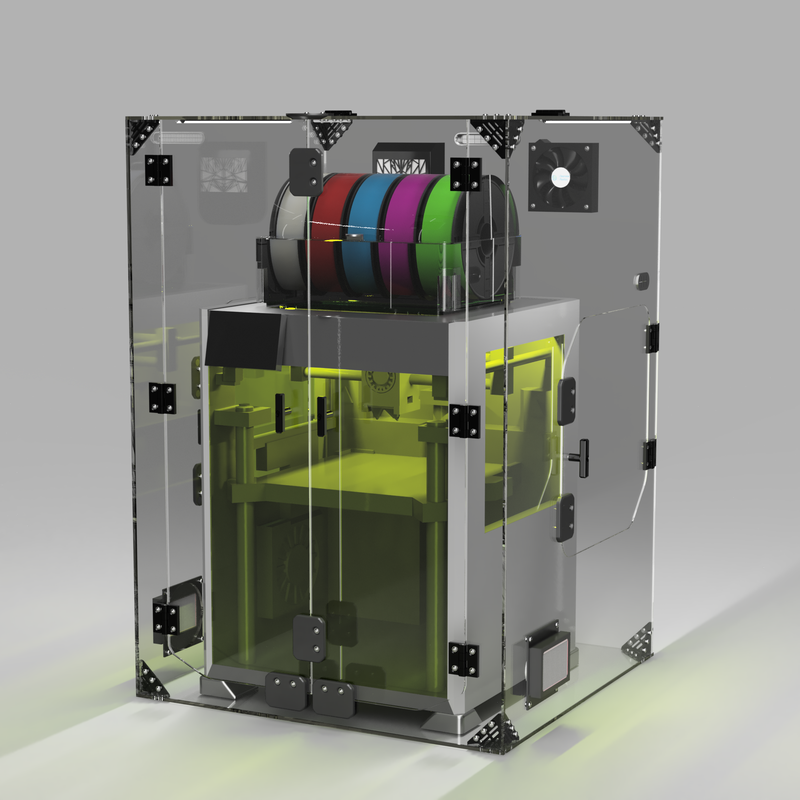
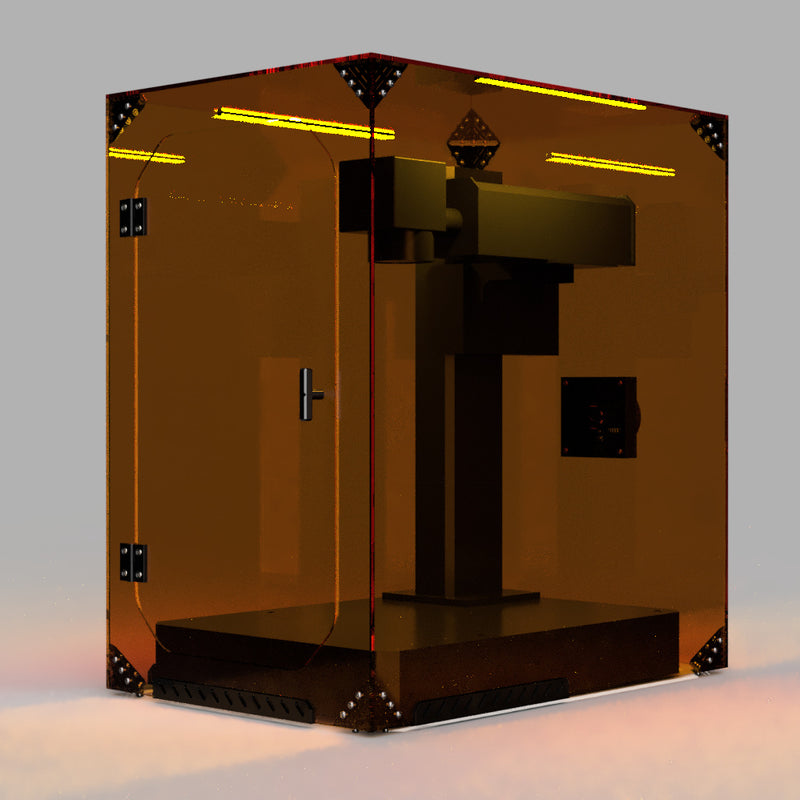
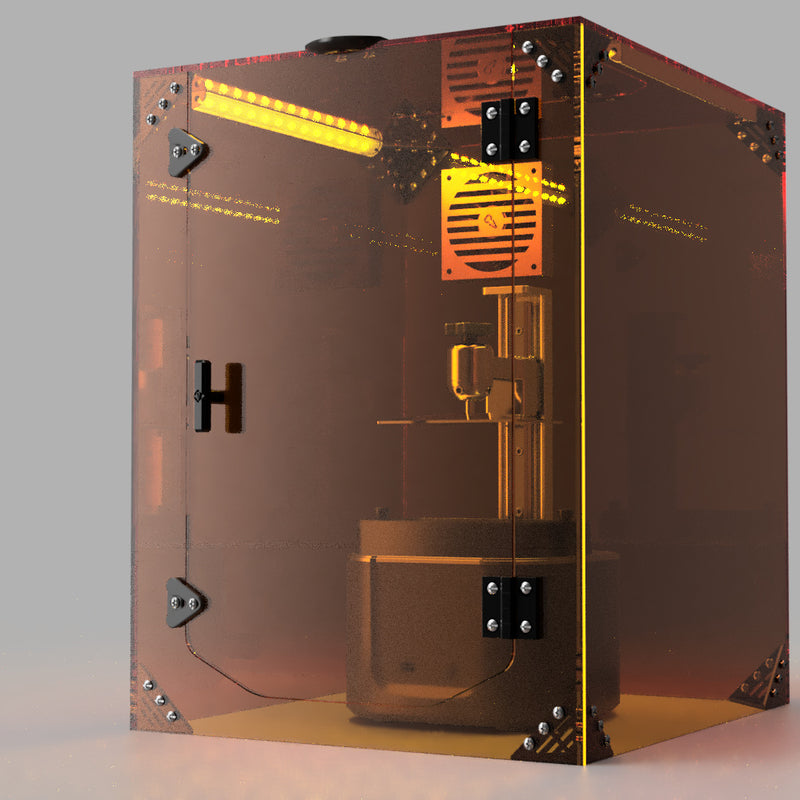
We get this question constantly: "What table fits your enclosure?" So here's the real answer — the actual dimensions, heights, and weight ratings you need, whatever you set it on. Because most people don't learn this until a print fails: the table isn't furniture. It's part of the machine.
Why the table matters more than you think
A 3D printer flings mass around at speed, thousands of direction changes per print. Every one is an impulse into whatever it sits on. A table that flexes sends that energy back as resonance — which shows up in your parts as ringing and ghosting, those faint echoes trailing every corner. You didn't get a bad printer. You got a bad table.
CoreXY vs. bed-slinger — they are not the same table problem
This is the part almost nobody accounts for. A CoreXY machine (Bambu X1C, X2D/P2S, H2, Centauri Carbon 2, Snapmaker U1) moves a relatively light toolhead inside a fixed frame. A bed-slinger (Bambu A1, A2L, Elegoo Neptune 4 Max, Anycubic Kobra 3 Max, Creality SparkX i7) throws the entire print bed — plus your part — back and forth on the Y axis. That's real mass in motion, and the momentum goes straight into the table as low-frequency rocking.
The bigger the bed, the bigger the shove — and it gets worse as the print gets heavier, which is why a 20-hour job can start clean and end with layer shifts. If you run a large-format bed-slinger, weight the table decision toward rigidity and load rating, not just footprint.
The four numbers that decide fitment
-
Footprint — the top must be at least as big as the enclosure's base (not just the machine's).
-
Overhang — 1–2 inches of table beyond the enclosure on each side, for stability and easy leveling.
-
Height — so your loading and viewing zone lands at a comfortable working level. Taller enclosures want a lower table.
-
Load rating — machine + enclosure + a safety margin for motion. This is the one people blow, and the one that gets dangerous.
Fitment specs — our most popular enclosures
Measured by enclosure exterior. Bigger and heavier always wins.
| Enclosure |
Exterior (W×D×H) |
Min. table top |
Height |
Min. load |
| Bambu A1 Kit |
19.5 × 23.5 × 23.75 in |
22 × 25 in |
28–32 in |
80 lb |
| Bambu A2L Kit |
23 × 31 × 27 in |
25 × 33 in |
28–32 in |
100 lb |
| Bambu X1C / P1S / P1P V2 |
22 × 23.5 × 24 or 31.5 in |
24 × 25 in |
28–32 in |
100 lb |
| Bambu X2D / P2S V4 |
23.75 × 23.5 × 24 or 31.5 in |
26 × 25.5 in |
26–32 in |
120 lb |
| Bambu H2 — Standard |
22 × 25.5 × 29 in |
24 × 27 in |
28–32 in |
150 lb |
| Bambu H2 — XL (+AMS2) |
27 × 25.5 × 38 in |
29 × 27 in |
26–30 in |
150 lb |
| Centauri Carbon 2 Combo |
24 × 23.5 × 31.5 in |
26 × 25.5 in |
26–30 in |
120 lb |
| Snapmaker U1 |
24 × 23.5 × 31.5 in |
26 × 25.5 in |
26–30 in |
120 lb |
| Creality SparkX i7 |
19.5 × 25.5 × 21 in |
22 × 27 in |
28–32 in |
80 lb |
| Elegoo Neptune 4 Max |
26.2 × 39 × 31.5 in |
28 × 41 in |
26–30 in |
150 lb |
| Anycubic Kobra 3 Max |
31 × 39 × 32 in |
33 × 41 in |
26–30 in |
175 lb |
| eufyMake E1 — Standard |
27.15 × 19 × 17.75 in |
30 × 21 in |
30–34 in |
120 lb |
| eufyMake E1 — XL |
27.15 × 35 × 17.75 in |
30 × 37 in |
30–34 in |
120 lb |
| UV / Fiber Galvo Laser |
configurable |
your size + 2 in/side |
30–34 in |
100 lb+ |
| OrangeStorm Giga |
floor-scale, ~230 lb machine |
floor / ≤12 in base, ≥44 × 44 in |
floor |
400 lb |
The depth trap
Width gets all the attention and depth is what actually kills a setup. Most desks and workbenches are 24–30 inches deep. Four of our enclosures blow straight past that:
-
Anycubic Kobra 3 Max — 39 in deep (and 31 in wide). This needs a real bench, not a desk.
-
Elegoo Neptune 4 Max — 39 in deep. A standard table leaves the back of the enclosure hanging in mid-air.
-
eufyMake E1 XL — 35 in deep. Measure before you order the XL.
-
Bambu A2L — 31 in deep. Deeper than it is wide, and deeper than most desks.
Overhang isn't just untidy — on a bed-slinger throwing mass front-to-back, an unsupported rear edge is a tipping risk. Measure depth first.
Two things people forget: door swing and enclosure height
Side doors need room. The Centauri Carbon 2 Combo and Snapmaker U1 both have generously sized 19" doors on the left and right panels. That's why access is so good — but wedge one between a wall and a shelf and you've given up the feature you paid for. Leave swing clearance on both sides.
Tall enclosures want a lower table. A 31.5" enclosure on a 32" table puts the top hatch above eye level for most people. For the H2 XL, X2D/P2S tall, Centauri Carbon 2, Snapmaker U1, Neptune 4 Max, and Kobra 3 Max, drop to a 26–30" table so you can still reach into the top of the build volume.
Can you just use an IKEA table?
Straight answer: sometimes — but going by the enclosure size (not the printer) changes the math. An IKEA LACK is 21.65 in square, and most of our enclosures are deeper than that.
-
Bambu X1C/P1S: our V2 enclosure is 22 × 23.5 in — just bigger than a single LACK. Use a ~24 in top, or two LACKs side-by-side (which also fixes the weight rating). A great budget route done right.
-
Bambu A1: 23.5 in deep — overhangs a LACK front-to-back. Two LACKs or a deeper top.
-
Creality SparkX i7: 25.5 in deep — overhangs a LACK by nearly 4 inches. Go deeper.
-
Bambu X2D/P2S, A2L, Centauri Carbon 2, Snapmaker U1, H2: all too big for a single LACK — use a solid workbench.
-
Neptune 4 Max, Kobra 3 Max: not a chance. These need a purpose-sized bench.
-
OrangeStorm Giga: no consumer table. Floor-grade base rated 400 lb+, full stop. It's the machine's weight, not a preference.
Where a generic table falls short: it isn't sized to the enclosure's real footprint, it wobbles under a fast machine (hello, ringing), it's under-rated for the weight, and it leaves you to solve ventilation clearance and cabling yourself. For a light machine on a sturdy top, that tradeoff is totally fine. For a big bed-slinger, it isn't.
When a purpose-built base makes sense
If you'd rather not solve the footprint-height-load-ventilation puzzle yourself — or you're an institution, lab, school, or shop that wants one delivered, guaranteed-fit unit — that's what our parametric enclosure workstation is for: cut to your exact enclosure, rated for the real load, with ventilation and cabling already solved. Not the cheapest, never meant to be. The one that fits, holds, and lasts.
Not sure which spec fits your setup? Send us your machine model and enclosure size and we'll confirm the exact footprint, height, and load rating — whether you build it, buy a table, or have us make the base.
Clearview Plastics · Rocklin, CA · precision-cut acrylic and polycarbonate enclosures for desktop manufacturing.