

UV Printing on Acrylic
UV flatbed printing on rigid stock — Rocklin, California
UV printing on acrylic.
Printed and cut in the same building.
Send a print-ready file. We print direct to acrylic, polycarbonate, ACM or PVC on a 98 × 51-inch Mimaki flatbed, cut it to shape on the CNC router or laser, and ship it flat. Sign shops, print shops and display companies: send production files, we blind-ship under your paperwork.
Print bed
98 × 51 in
2,500 × 1,300 mm · full 4 × 8 sheets
Stock thickness
up to 2 in
50 mm on the flatbed
Ink
CMYK + white
White flood coat standard · varnish on production runs
Trade
Blind-shipped
Resale pricing on account · $500 minimum order

Full-sheet UV print behind clear acrylic with a white flood coat, edges polished. The sheet is the wear layer.
Why print, ship, then cut goes wrong
The sheet leaves flat and comes back a sixteenth out of register. You eat the remake.
A printed part that also gets cut to shape has two coordinate systems that have to agree: where the ink lands and where the cutter runs. Split them across two vendors and somebody has to own the difference. That somebody is whoever quoted the job.
You carry the printer’s bleed, the cutter’s kerf, both lead times, and the freight between them. When it comes back with a white sliver down one edge or a hole a sixteenth off the printed border, the reprint is not on their invoice. Under one roof, one vector file drives both machines and the cut path shares an origin with the artwork.
Split across vendors
Print → freight → cut → freight → you inspect registration → you explain the remake. Two quotes, two schedules, one margin.
One shop
Your file → proof with the cut path drawn over the art → print → cut → packed flat, blind-shipped. One quote. One schedule.
What we print
Four ways this gets used.
Direct-to-substrate printing
Full-color graphics printed straight onto cast acrylic, polycarbonate, aluminum composite, expanded PVC, HDPE and plywood. No laminate, no mounted vinyl, nothing to peel at the corner in eighteen months.
Print and contour cut
Shapes, radii, slots, holes and score lines cut to the same file that drove the print. Dimensional letters, custom-shape panels, nested short runs off a single sheet.
Second-surface & backlit
Artwork printed mirrored on the back of clear stock with a white flood behind it, so the graphic is read through the sheet. The standard for anything handled, lit from the edge, or living on a retail floor.
Trade & wholesale
No flatbed, no CNC, or both machines already loaded? Send production-ready files and we print, cut, fit the hardware and blind-ship to your customer under your paperwork — a finished unit, not a flat pack for you to assemble. Resale pricing on account.
Ask for a trade account with your first quote.

What ships: the parts, the signed proof they were cut to, hardware and the guide, packed flat.
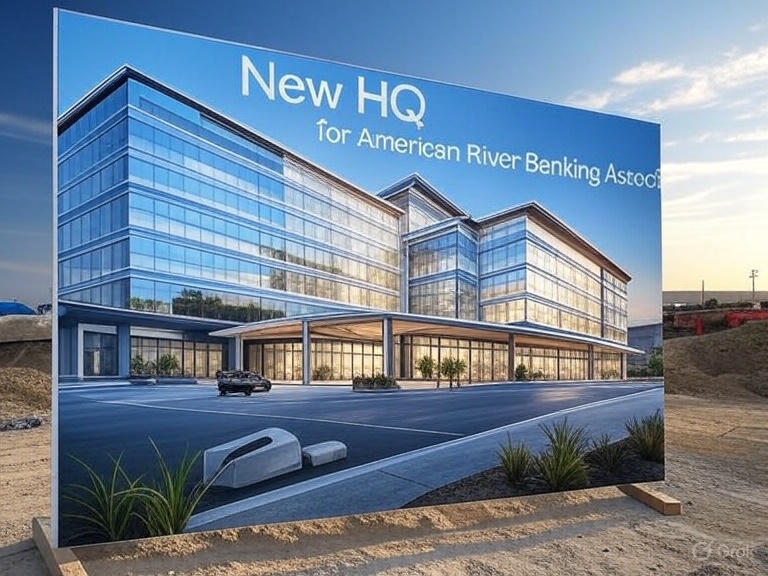
Concept art, shown only to illustrate capabilities. Not endorsed by Nike.

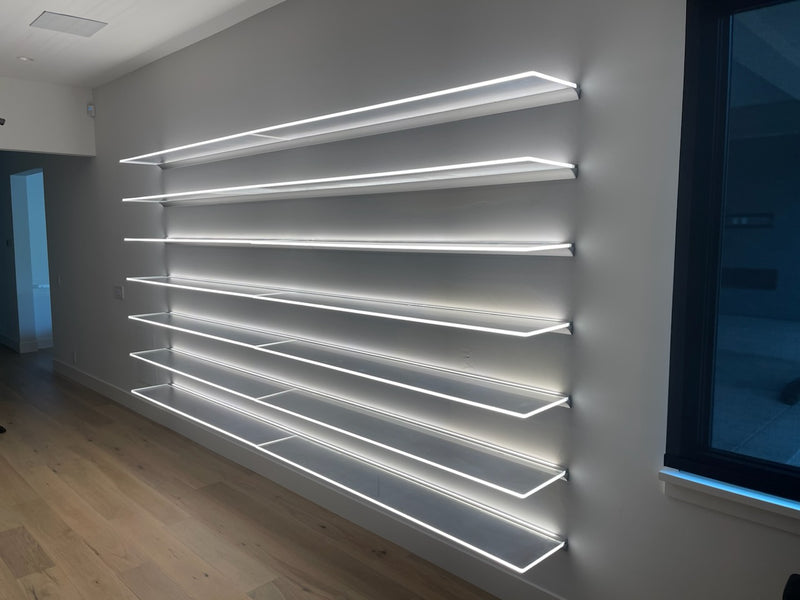
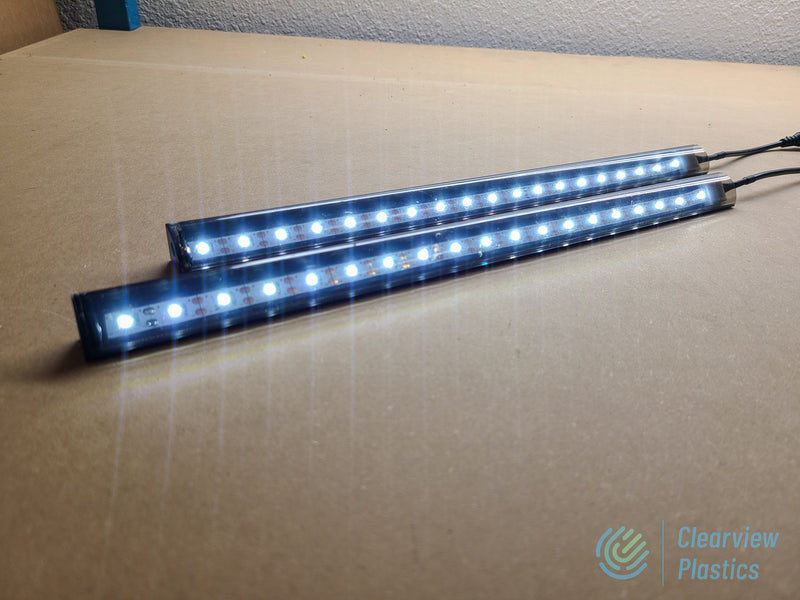
Edge-lit panel: second-surface graphic, polished edges carrying the light.
Concept art, shown only to illustrate capabilities. Not endorsed by Nike.
How the print lands where the cut says
Two ways to hold registration. We pick the one your part needs.
Path A
Cut first, print in a jig
The router cuts your blanks and a registration jig from the same DXF. Blanks drop into the jig on the flatbed and the print file shares that origin. Registration error is the jig’s clearance, not a guess. This is the path for graphics that bleed to a cut edge, printed borders, printed edges on thick stock, and all second-surface work.
Path B
Print first, cut to fiducials
The flatbed prints your nested artwork plus registration marks across a full sheet. The router or laser locates the marks and cuts every outline. The fast path for short runs of simple shapes where dozens of parts come off one sheet.
Before either one
A proof with the cut path on it
Every job gets a PDF proof with the cut path drawn over the artwork before a sheet is loaded. Bleed, safe margins and hole positions get checked while it still costs nothing to change them. You approve it; then we run.
Capabilities
What is on the floor.
| UV flatbed printing | Mimaki JFX200-2513. Print area 2,500 × 1,300 mm (98.4 × 51.2 in), media to 50 mm (2 in) thick, 300–1,200 dpi, LED-UV cured. CMYK with a white flood coat as standard; white-and-varnish ink sets for production runs. Multilayer in one pass: color over white, white over color, second-surface, spot varnish. |
| CNC routing | AXYZ 4012 router, sheets up to 5 × 10 ft. Contour cutting, pocketing, drilling, countersinks, slots and tabs for flat-pack assembly, scored fold lines, registration jigs. |
| Laser cutting & engraving | CO2 lasers, 50 × 36 in bed, for fine-detail acrylic cutting with a flame-polished edge straight off the machine, engraving and mask scoring. A 30 W fiber laser marks metal directly — anodized aluminum, stainless and similar — a permanent mark with no ink to wear off. |
| 3D printing | Brackets, standoffs, clips, feet, spacers and adapter parts, plus custom jigs and fixtures, printed in-house from the same file set as the cut path — so a printed panel mounts to whatever it has to mount to. |
| Hardware integration | Standoffs, brackets, threaded inserts, magnets, VHB and fasteners fitted before the part ships, so it arrives ready to mount instead of as a bag of hardware and a diagram. |
| Small-format printing | A eufyMake E1 desktop UV printer covers small items and short runs, so a handful of small parts does not sit in the queue behind a full sheet on the flatbed. |
| Materials | Cast acrylic (clear, frosted P95, colors, black, white), polycarbonate, aluminum composite (ACM), expanded PVC, HDPE, Baltic birch and hardwood plywood. Customer-supplied stock on request. |
| Quote & lead time | Quotes within one business day of receiving files. Most print-and-cut jobs ship in 5–10 business days. $500 minimum order. Ships nationwide, packed flat, blind-shipped for trade accounts. No installation. |
File preparation
Send it like this and the quote comes back faster.
Artwork
Vector PDF, AI or EPS at 1:1 scale. Fonts outlined. Raster images embedded at 150–300 ppi at final size. CMYK; name any brand colors by Pantone and we match on the proof.
Cut path
A separate layer named CutContour, or a DXF at 1:1 in inches or millimeters — say which. Holes, slots and score lines on their own layers.
Bleed and margins
Extend artwork 0.125 in (3 mm) past every cut edge. Keep text and fine detail 0.125 in inside the cut edge and 0.25 in from any hole.
White and varnish
Put white on a spot-color layer named White and spot varnish on Clear. For second-surface work, send the art as you want it seen — we mirror it.
Not print-ready yet?
Send a sketch with dimensions and the logo. We do the CAD and print prep and put it on the quote as its own line item, so you see what it costs before we start.
Who we print for
Sign shops, display houses, and the labs that buy our enclosures.
Clearview Plastics has shipped engineered acrylic and polycarbonate parts to Lockheed Martin, MIT Lincoln Laboratory, Oak Ridge National Laboratory, Jefferson Lab, Pacific Northwest National Laboratory, the U.S. Air Force, Navy, Army and Marine Corps, NOAA, and universities from MIT and Michigan to Texas A&M and UT Austin. Same machines, same file discipline, same receiving-department-ready paperwork on trade print work.
Made in California. One-year warranty against manufacturing defects.
Questions we get
Straight answers.
Do you print white?
Yes. A white flood coat is standard, which is what makes color read correctly on clear, colored or dark stock, and it is what sits behind a second-surface print. Production runs can move to a white-and-varnish ink set.
Will the print scratch?
Surface-printed UV ink marks under abrasion, the same as any printed surface. For parts that get handled we print second-surface behind clear stock so the sheet is the wear layer, or flood clear varnish over a face print. Tell us how the part lives and we spec the right one.
Can you print on my material?
Usually. Rigid, flat, under 2 inches thick and inside the bed’s weight limit. Send a sample if it is something not on our list — adhesion on some surfaces needs a primer pass, and we test before quoting rather than after.
Do you work trade, and will you blind-ship?
Yes to both. Trade accounts get resale pricing and we ship to your customer with your paperwork and nothing of ours in the box. Ask for an account when you send your first file.
Is there a minimum?
$500 minimum order, quantity one and up. No plate, screen or tooling charge. Setup is a line on the quote, so a single piece costs what a single piece costs and a run of 300 gets the per-piece number.
Outdoor, UL, chemical resistance?
We state what we have tested and nothing else. Second-surface acrylic and polycarbonate hold up well indoors and in light-duty industrial environments. If the job needs a rated overlay or an outdoor-weathering spec, say so and we will either test to it or tell you who to call.
Request a quote
Send the file.
Material and thickness, finished size, quantity, and where it ships. Attach the artwork and cut path — or a dimensioned sketch, which is enough to quote from. Mention a trade account if you want one. You get a number within one business day.
Also from this shop
Cut + Print overview · Nameplates & panel graphics · Acrylic sheet fabrication · B2B job shop
Send the file. Get the number tomorrow.
Artwork, cut path, material, quantity, ship-to. If you only have a sketch, send the sketch.
Clearview Plastics · 4235 Pacific St, Suite H, Rocklin, CA 95677 · Ships nationwide
- Choosing a selection results in a full page refresh.