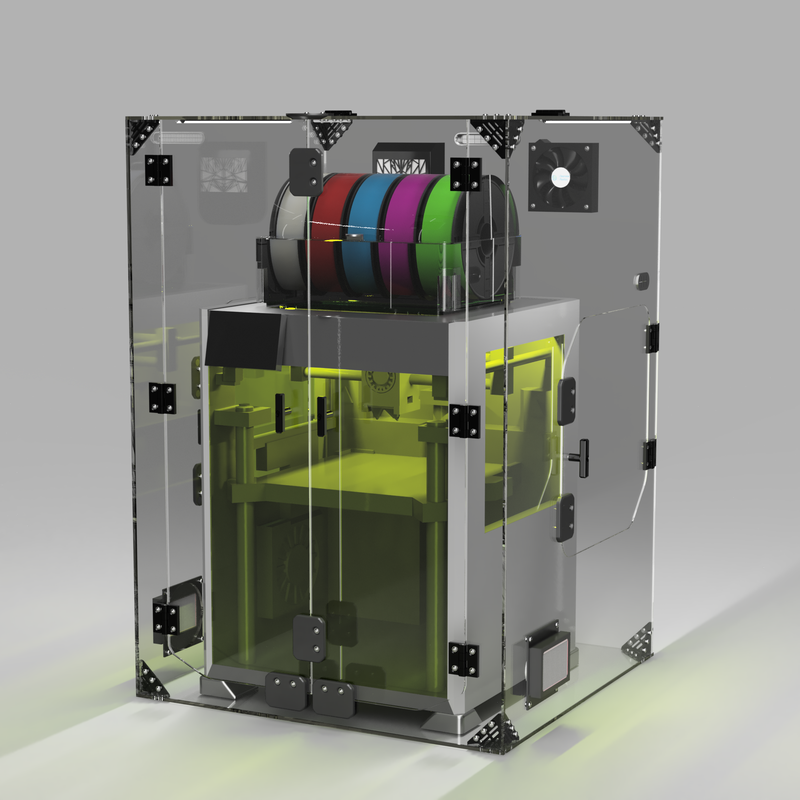
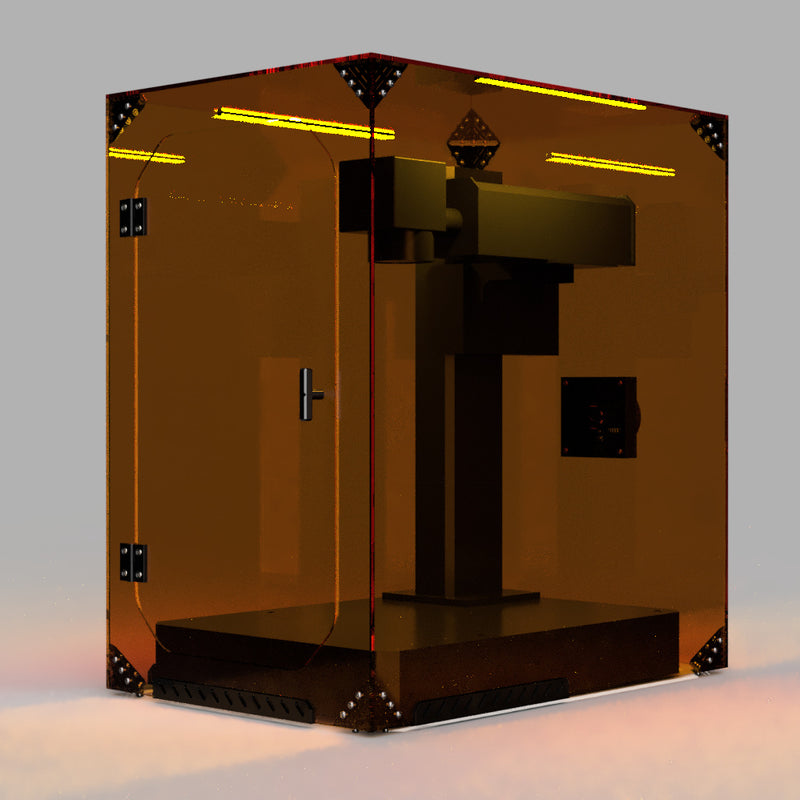
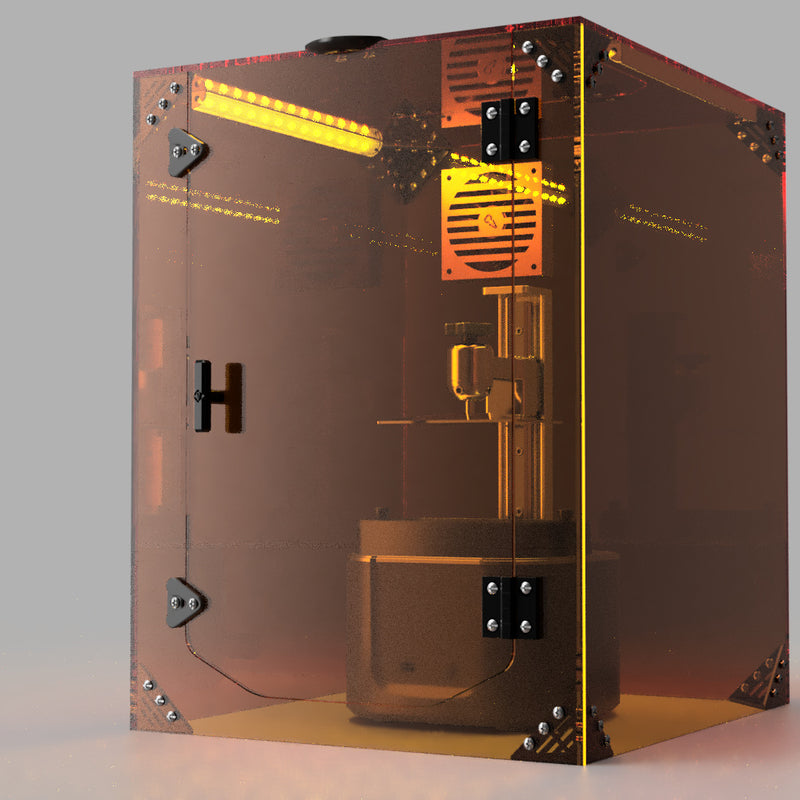
We're handy guys at retrofitting an enclosure around almost any machine. The order of operations: find a standard enclosure that fits first, because stock is faster and less expensive; go custom when the machine or the workflow genuinely needs it.
Can you make a custom enclosure for my machine?
Yes. Start by telling us the machine and what the enclosure needs to do — fume control, laser safety, chamber temperature, dust. If a standard Clearview enclosure fits, we'll point you at it; it's the faster, less expensive option and ships in 10 business days or less. If not, we build custom around your machine. The sky is the limit, but customization has its own realities: it affects workflow, takes longer, and carries a larger price point.
How do I get a custom enclosure price?
For a ballpark, the custom safety enclosure calculator takes dimensions and the common options and gives an instant price; the aluminum-framed custom enclosure page does the same for extrusion-framed builds. For a firm quote, send three things: the outside dimensions you need (width x depth x height), a rough plan for the access doors, and where the exhaust should exit. A sketch or a photo of the machine helps. We send a basic dimensioned diagram to approve, then a formal quote.
How long does a custom enclosure take?
Custom enclosures ship 21 to 30 business days after design approval and deposit. Standard enclosures ship in 10 business days or less, which is one of the reasons we look for a standard fit first.
Which panel material should a custom enclosure use?
- Standard 3D printers: acrylic — clearest, most economical.
- Resin printers and IPA wash stations: polycarbonate — acrylic can crack at the edges with solvent exposure.
- High chamber temperatures: Heavy Duty polycarbonate.
- Outdoor or UV-exposed: polycarbonate — UV-stable, won't yellow.
- Diode and UV lasers (below 550 nm): laser-filtering acrylic for the window.
- Fiber and IR lasers (1064 nm): aluminum composite walls with a laser safety viewing window. Clear or tinted plastic is not a barrier at this wavelength.
- Sound enclosures: expanded PVC walls for vibration damping with an acrylic front for visibility.
Can you enclose two printers in one box?
We can, and for two machines we'll usually recommend two separate enclosures instead: independent thermal control, easier service access, and the combined custom unit tends to cost the same or more. The exception is when one shared exhaust run genuinely matters to your layout. For larger installations, the Rapid Deployment Print Farm Array is the multi-printer safety enclosure.
Do you make enclosures for dispensing robots, lab automation, and desktop robots?
Yes. There are listings for Nordson EFD, Fisnar, Janome, Musashi, Dispenser Tech, Opentrons, CELLINK, and Voltera machines, and each is built to order around the machine — CNC-cut panels on our bracket system, flat-packed, with front and top access for loading and unloading, exhaust ports, and wire grommets. The closest reference layout is the Universal Laser Engraver Enclosure V3, which has a walkthrough video on the listing. Send the machine footprint, where the exhaust should exit, and what the machine dispenses, and we'll confirm the layout and price.
Do you make bolt-on panels or OEM enclosures for equipment manufacturers?
Yes. We work with equipment makers on bolt-on panel sets and enclosures that ship with their machines. Send the machine drawings or a sample unit and the quantities you're planning, and we'll scope it. The B2B plastics job shop page covers the fabrication side.
Do you have distributors in Europe or elsewhere?
No distributors anywhere. Everything is designed and built in our shop in California and ships direct from here. International shipping is no problem; import duties and VAT/GST are settled with the courier at delivery.
Last updated 2026-10-08.