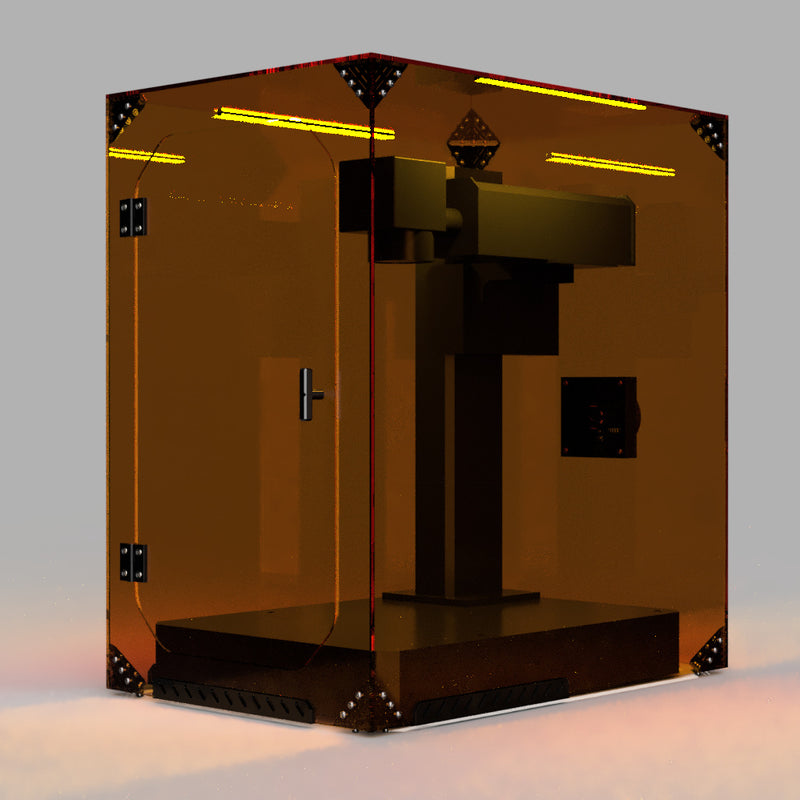
Short version: our enclosure doesn't change your laser's class, and it isn't a certified Class 1 product. What it does is contain the beam path and the fumes, with a laser safety viewing window and door interlocks — the physical control measure your safety program is built around.
Is your laser enclosure Class 1?
No, and the terminology is worth thirty seconds because it trips people up. A Class 1 laser is a low-power source that's safe on its own. A Class 1 laser product is a machine with a powerful laser inside, made safe by its housing — and enclosing a Class 4 laser is exactly how one of those gets built. That designation isn't created by adding an enclosure, though. It's created when someone tests the finished assembly, documents it, certifies it with the FDA, and signs for it, which makes them the manufacturer of a laser product. Companies that sell the whole machine can do that because they built the whole machine. We supply the enclosure into a machine you already own, so we aren't in a position to certify it. What our enclosure gives you is beam and fume containment, a laser safety viewing window, and door interlocks that inhibit operation when it's opened.
Can you build or certify a Class 1 enclosure for me?
We aren't offering a certified Class 1 enclosure at this time. A certified Class 1 setup is a laser workcell: the source, housing, interlocks, and controls engineered and tested as one assembly and filed with the FDA. What we put behind your installation is the enclosure — which includes the features a Class 1 laser product is built on, the OD-rated viewing window and door interlocks — plus our Workplace Safety and Compliance document pack. For most teams that's what "make this compliant" actually requires. If Class 1 certification is written into your contract or customer spec, you need a certified workcell vendor, and we'll say so.
Does the enclosure come with any certifications?
We provide a Certificate of Conformance for your order: that the enclosure was built to the agreed drawings and specifications at our shop in Rocklin, California, with raw material certifications kept on file. The viewing window carries a documented optical density rating from its manufacturer. What we don't carry is a laser classification; that belongs to the finished laser product and to whoever certifies it.
What OD is the enclosure rated to?
OD (optical density) is a rating for things you look through — eyewear and viewing windows — at one specific wavelength. An enclosure isn't an optic, so it doesn't carry an OD number; only the window does. The window's OD rating and wavelength are stated on each laser enclosure's product page. The walls on the fiber and IR enclosures are aluminum composite with an opaque metal skin, so there's no transmission to rate — a different kind of barrier, not a weaker number.
Do I still have to wear laser safety glasses?
The enclosure doesn't change your laser's class, so under ANSI Z136.1 your operators still wear the eyewear your safety officer specifies. We're never going to tell you to take glasses off. What the enclosure does is contain the beam path and the fumes, and give you a rated viewing window to work through.
Is the enclosure light-tight or sealed?
The goal isn't a sealed box — it's that there's no straight path from the work area to where anyone is standing. A laser beam travels in straight lines, so what matters is line of sight, not air-tightness. Panel joints are lapped so the overlap breaks the path, vents are placed and baffled so air turns a corner and light can't, and the exhaust penetration is offset. Sealing it completely would also work against the filtration: the enclosure's job is to contain and concentrate the fumes so the filter or exhaust can handle them, and that needs an airflow path.
Why aluminum panels on the fiber laser enclosure? Can I get clear panels so I can see in?
For a fiber laser this is the single most important thing to get right. Clear acrylic and polycarbonate are essentially transparent at 1064 nm — they'd look like a solid wall to you and be an open window to the beam. Tinted or black plastic isn't a fix either; pigment that blocks visible light says nothing about infrared. That's why the walls are aluminum composite and the only thing you look through is a purpose-built laser safety window.
Do I need a Laser Safety Officer?
If you're operating a Class 3B or Class 4 laser in a workplace, ANSI Z136.1 says yes: the employer designates one. It doesn't have to be a full-time role or an outside hire; plenty of shops designate someone internal who takes the training. Their job is to evaluate your specific installation and decide what controls it needs. We can't be your LSO and neither can any equipment vendor. What we can do is give them a physical control measure and a documented program to work from.
Our EHS team says we need to be compliant. What do we actually need?
Four things, and none of them is a class sticker:
- An engineering control — an enclosure that contains the beam, with a rated viewing window and interlocks on the openings.
- Administrative controls — a controlled area, signage, entry rules.
- PPE — eyewear specified for your wavelength and power.
- A documented program — a designated LSO, a hazard assessment, training records, and written procedures.
An auditor or insurer asks to see the paperwork behind items 2 through 4. That's what our Workplace Safety and Compliance document packs are: hazard analysis, engineering controls, PPE hazard assessment certification, LSO program structure, lockout/tagout, training checklist, signage templates, and the maintenance and incident logs, written against ANSI Z136.1-2022, IEC 60825-1, FDA 21 CFR 1040, and the OSHA General Duty Clause. See the safety documentation page for the packs by machine type.
Do you have test data on the panels?
The viewing window carries a documented optical density rating at its wavelength from the manufacturer, and we can send that datasheet. On the panels: aluminum composite has a metal skin, so it's opaque rather than attenuating — there's no transmission number to publish.
What if we genuinely require a certified Class 1 system?
Then you need a certified laser workcell, not an aftermarket enclosure — a vendor who builds the machine and enclosure as one assembly and certifies it with the FDA under their name. If the requirement turns out to be softer than that — a safety officer wanting the installation properly controlled and documented — what we build is your answer.
Last updated 2026-10-08.