

Military & Shipboard Enclosure Development
Research & development program — current status published below. Last updated: August 2026.
Manufacturing is moving to the point of need
Additive manufacturing and laser part-marking are no longer confined to shore-side depots. Machines are being installed where the work is: aboard ship, at forward operating locations, and inside mobile maintenance facilities. A part made and marked on site is a part that doesn't wait months in a supply chain.
That shift creates an equipment problem nobody solved on the way there. A 3D printer or fiber laser designed for a climate-controlled shop floor does not automatically belong in a steel compartment at sea. The machine needs an enclosure that treats the environment as the design driver — not an afterthought bolted on at the end.
Clearview Plastics is engineering its modular enclosure line toward exactly that requirement.
What makes a shipboard enclosure different
Five constraints govern, and each one eliminates a common design:
- Shock. Naval equipment is evaluated for survival of a high-impact shock event. Even where a unit is permitted to stop working, it must remain intact — nothing may fragment, tear loose, or become a hazard to personnel or to adjacent critical equipment. Brittle panel materials and adhesively bonded assemblies are poor candidates.
- Fire, smoke, and toxicity. A concealed flammable core inside a sealed compartment is a serious hazard. Material selection has to be defensible on flame spread, smoke density, and combustion toxicity — not just on optical clarity or cost.
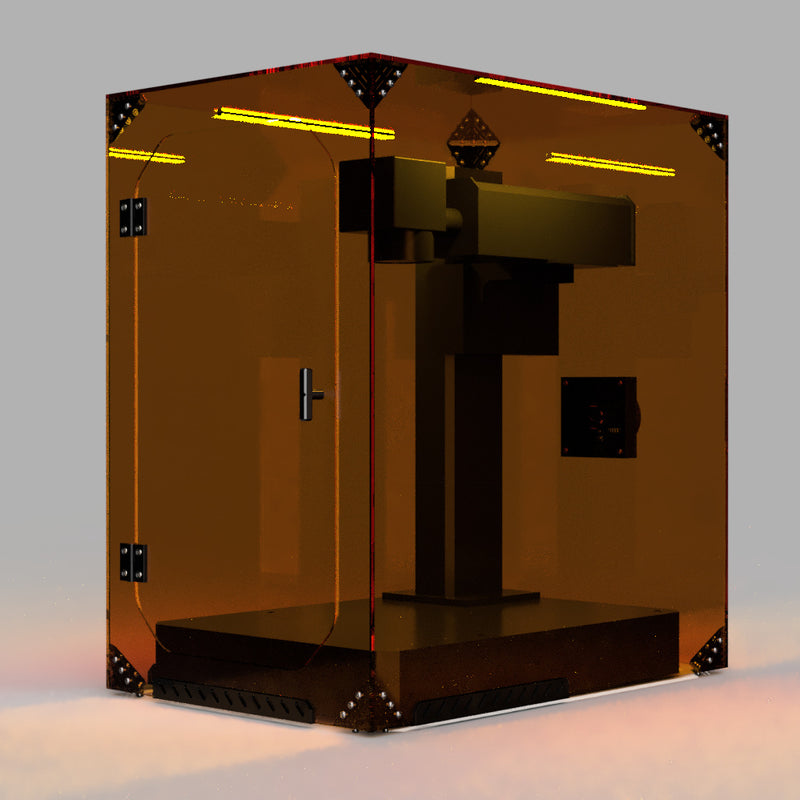
- Laser containment. At 1064 nm, a fiber laser's beam is invisible. A seam that appears light-tight to the eye can still pass infrared radiation. Containment is a design requirement, not an inspection step.
- Corrosion. Marine service demands marine alloys and disciplined isolation between dissimilar metals.
- It has to fit through the door. This is the constraint most suppliers discover last. A standard shipboard watertight door is roughly 26 by 66 inches; a scuttle is smaller still. A welded enclosure that cannot pass through the opening cannot be installed, regardless of how well it is built.
Why we think our architecture is the right starting point
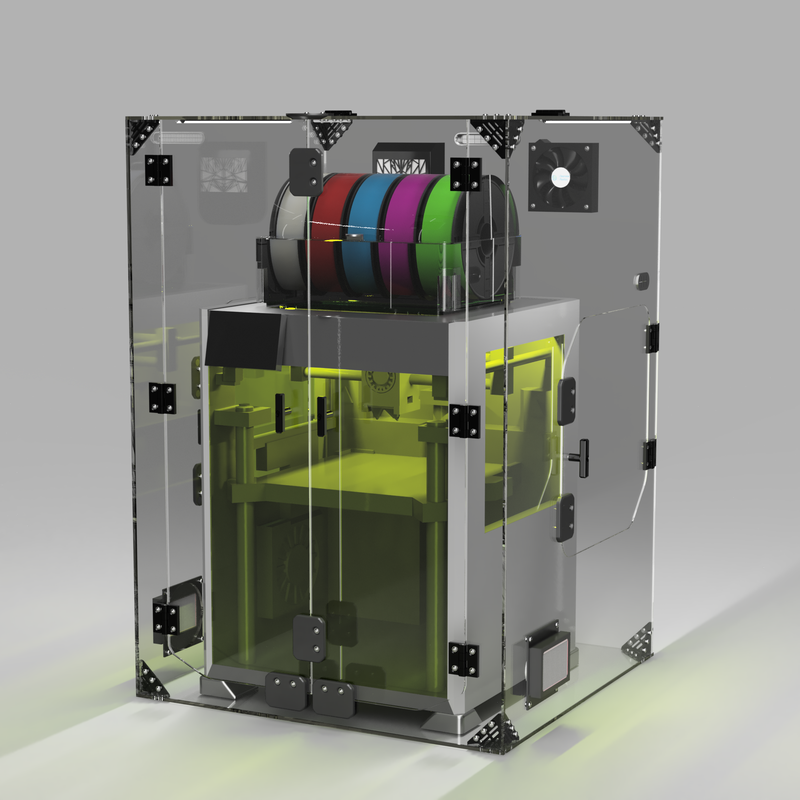
Clearview enclosures are panelized and fastener-assembled by design. They were built that way for freight cost and field serviceability in commercial settings — but the same architecture answers the hardest shipboard constraint directly.
A modular enclosure ships flat, passes through the hatch in pieces, and is assembled in the compartment with hand tools. Panels are individually replaceable, so damage doesn't condemn the whole unit. Service access doesn't require moving the machine.
We are not adapting a welded box to a modular requirement. We already build modular. The development work is in materials, hardware, and compliance documentation.
What we are engineering toward
Our development program targets the following requirements. These are design objectives for products currently under development — see the program status note below.
- MIL-DTL-901E high-impact shock, Grade B retention criteria — structural integrity and anti-fragmentation under hammer-blow testing
- MIL-STD-167-1A shipboard environmental vibration
- Shipboard flammability, smoke, and toxicity criteria — flame-retardant polycarbonate glazing where transparency is required; solid marine-grade aluminum where it is not
- IEC 60825-1 and IEC 60825-4 laser safety and laser guard requirements, and 21 CFR 1040.10 — targeting Class 1 laser system classification for enclosed Class 4 fiber laser installations
- MIL-STD-461G electromagnetic interference, for enclosures incorporating powered subsystems
- Marine-grade material set — 5052 aluminum, 316 stainless hardware, corrosion-isolated joints
- Documented compliance packages with material traceability, supporting first article inspection and government source inspection
Program status
We want to be precise about where this stands, because precision is the whole point of the exercise.
This is an active research and development program. No Clearview Plastics product has completed MIL-DTL-901E shock qualification testing at this time. We do not represent any product as qualified, certified, or approved to any military specification. Nothing on this page should be read as a claim of government endorsement, affiliation, or an existing contract.
What we are doing is engineering deliberately toward these requirements, documenting design intent against the governing standards, and building the technical package that a qualification campaign would rest on. When testing is completed, we will publish the results and say plainly what was tested and what was not.
This page is updated as the program progresses. Status current as of August 2026.
What we bring to the table today
- A production modular enclosure line already in commercial service, including laser and high-temperature applications
- In-house design and fabrication — we control the iteration loop rather than waiting on a vendor
- Existing compliance documentation practice across CE, UL, RoHS, and REACH frameworks
- Staff with U.S. Navy service background, Naval instructor experience, a NAVOSH Safety Excellence Award, IPC certifications (J-STD-001, IPC-A-610, IPC-620, IPC-7711/7721), and certification as an ESD Program Manager under MIL-STD-1686B
- A small-shop posture: direct access to the people doing the engineering, and the ability to build a one-off before committing to a production run
If this is your problem, talk to us early
The best time to involve an enclosure supplier is before the requirement is written, not after. If you are planning a manufacturing capability for a shipboard, expeditionary, or otherwise constrained installation, we would rather understand your constraints now than quote against a specification that already excludes the right answer.
We are interested in conversations about installation environment and mounting configuration, shock grade and class requirements, hatch and passageway access limitations, laser containment and interlock architecture, fume extraction and filtration, and integration timelines.
Contact us to request a capability statement or to discuss an application.
Clearview Plastics is a trade name of Prospect Sporting Goods LLC. References to military specifications and consensus standards on this page identify design objectives of an ongoing development program. They do not constitute a claim of qualification, certification, listing, or approval, and do not imply endorsement or affiliation by the U.S. Department of Defense, the Department of the Navy, or any government agency. Specifications and program scope are subject to change.

- Choosing a selection results in a full page refresh.